
Designing BC's foreign worker quarantine
Five days, five ministries, a national model for migrant worker protection
Client
Government of British Columbia, Government Digital Experience Division (GDX)
Year
2020
My role
Service design, system mapping and design, graphic design, remote facilitation
Sectors
Agriculture, Government & Public Sector
In one line
A five-day service design engagement that built BC's multi-ministry quarantine system from scratch, safely bringing 15,000 foreign workers into the province during the first weeks of the pandemic.
The big idea
Coordination problems are design problems
Project team
Wil Arndt (service design, system mapping, graphic design, remote facilitation), Jacqueline Antalik (service designer), Joey Bevacqua (project manager), Dave Kachman (user experience designer), Gordon Ross (client engagement, service designer).
The challenge
The growing season was about to start. Thousands of foreign workers were on planes to BC in five days. The pandemic was a month old, lockdown was in effect, and the agriculture sector—which the province's food security depended on—saw incoming workers as a possible contagion vector. No plan existed to safely move them from airport to farm. No playbook existed for what to do when they got there. BC needed coordination across Agriculture, Labour, Health, Emergency Management, and IT—five ministries used to working in hierarchical silos, not to remote collaboration at crisis speed.
This was an issue of public safety, food security, and human dignity. But, more than that, the world was watching to see how BC would treat their foreign workers.
The approach
We had five days. The first decision was what artifact to coordinate around.
The map was the meeting
Cross-ministry coordination usually happens through memos, calls, and steering committees. None of those scale to five days during a pandemic with people who don't normally work together. A shared visual experience map does. One artifact, all five ministries facing the same thing at the same time. The map became the rally point—the thing everyone faced together.
Synchronous decisions, asynchronous design
I designed a cycle I called The Loop. Synchronous calls with senior representatives across ministries, screen-sharing the latest version of the map and walking through the worker journey step by step. As gaps surfaced—who owns inspections, what happens at the airport, who handles a symptomatic arrival—I named them on the spot and assigned them to specific people. Between sessions I rebuilt the map with the new answers, sometimes within hours. Then we looped again.
Staging fidelity to keep speed and clarity in tension
In live sessions, factual accuracy was the only goal. Sticky-note-grade markup layered on top of the existing map so everyone could see what was new and what was still being worked out. Between sessions, I refined to higher fidelity, because the map had a downstream audience too—farm operators, airport staff, translators. The same artifact served different audiences at different fidelities depending on the moment.
Letting the map surface work no one had named
A side effect of mapping fast was that the gaps became impossible to ignore. The need for pre-arrival farm inspections fell out of the map. The 14-day federal quarantine step exposed the need for translated handouts at the airport. The map coordinated the work. It also kept surfacing work no one had named yet.
The work
The experience map
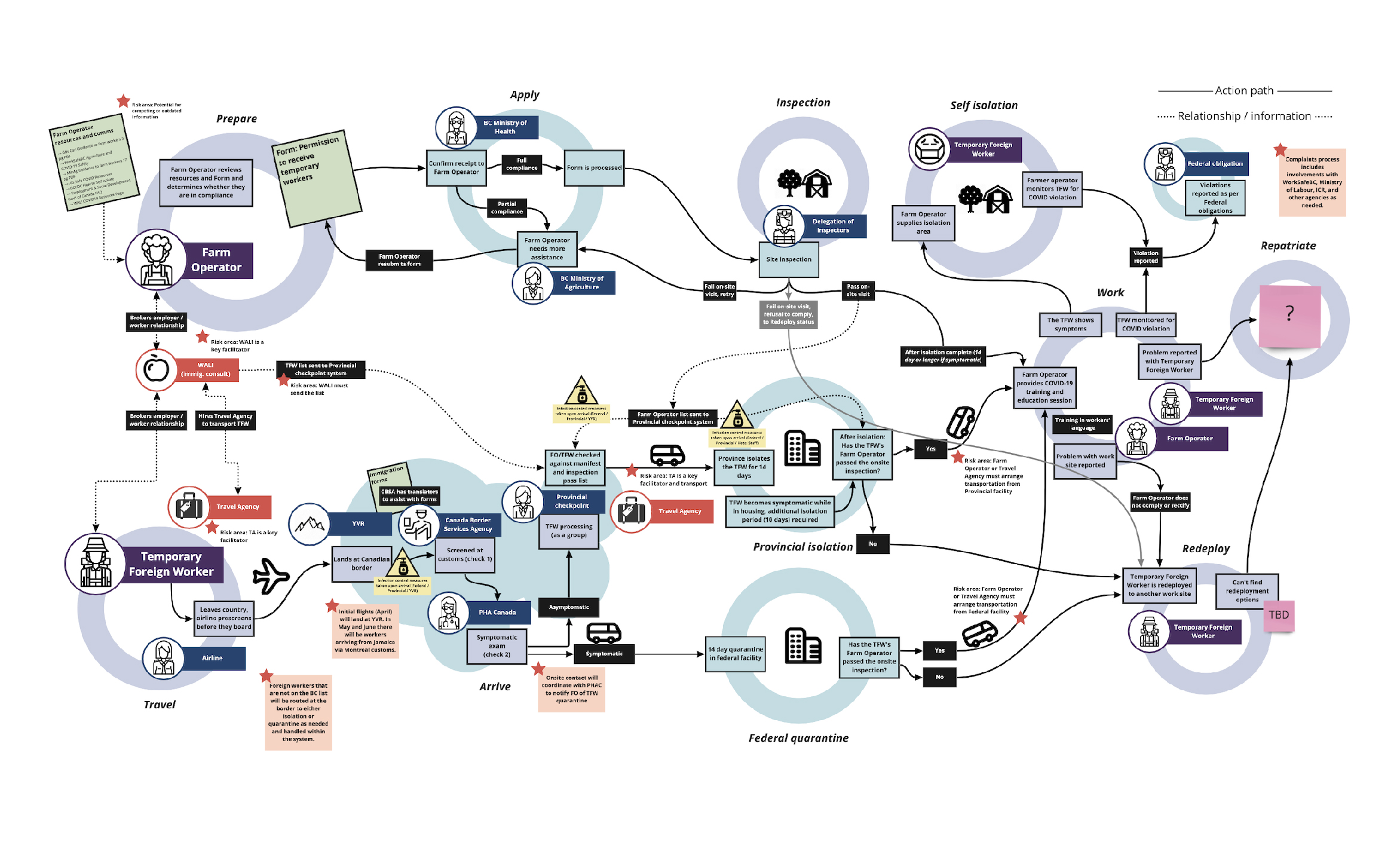
The artifact every ministry coordinated around. Started as a flow on day one and grew into the system specification that ran the program for two years. One map, five ministries, all hands on it in real time.
Iteration progression
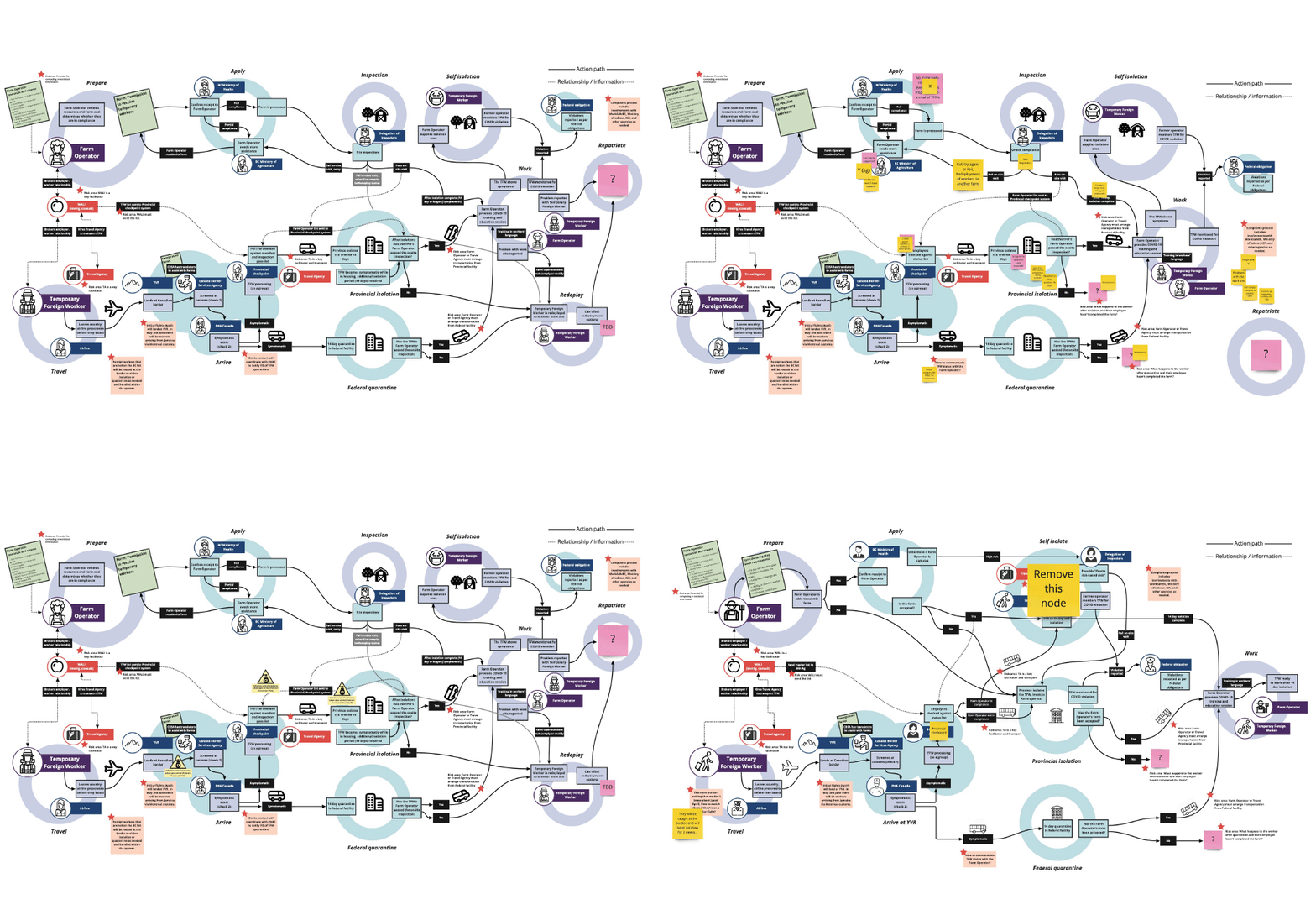
Three states of the map, showing how fidelity changed with purpose. Sticky-note layering for live decision-making, mid-fidelity for the next round of stakeholder review, higher fidelity when the map became the operational document handed to farms and airports.
Digital infrastructure for farm employers
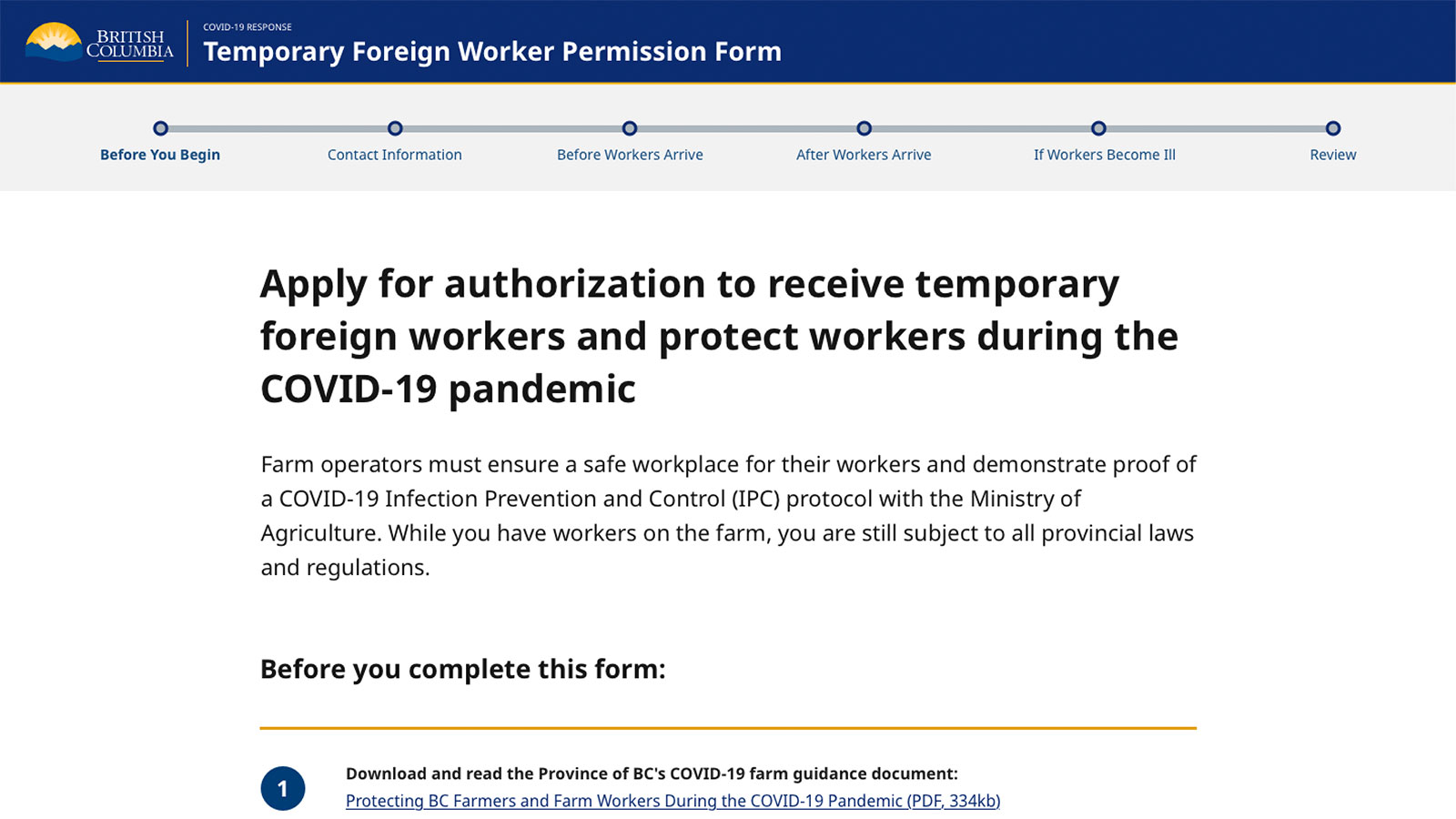
The farm operator permission form, designed and deployed before the first workers landed. It was one of several downstream pieces the mapping made obvious: tracing the journey end to end surfaced gaps no single ministry was positioned to see, including bilingual airport handouts for workers arriving from Mexico and Jamaica into an English-only process.
The outcome
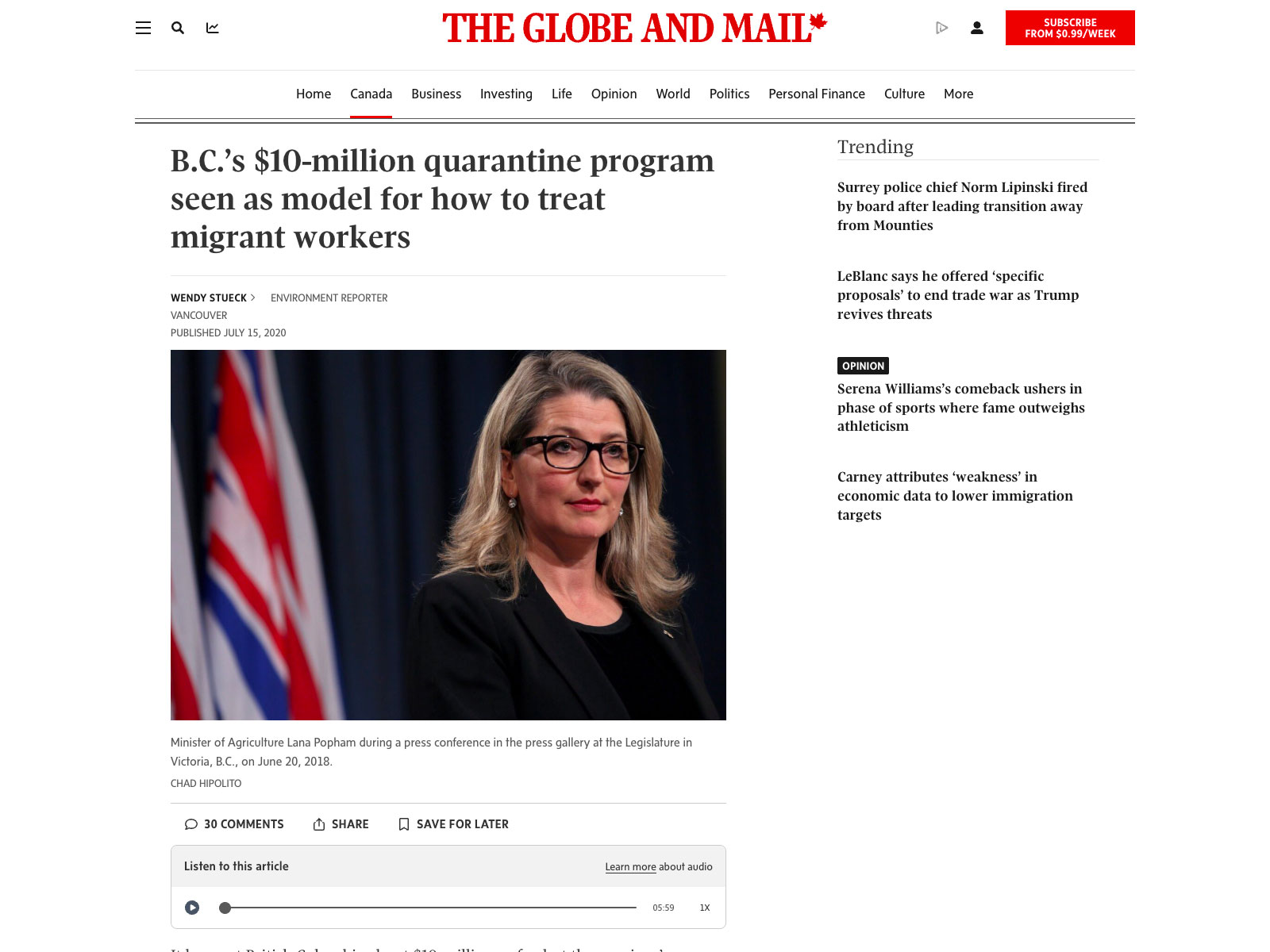
National recognition, three months in: BC's Minister of Agriculture calls the program a model for treating migrant workers.
The system worked. Over two years, BC safely brought 15,000 foreign workers into the province. The quarantine protocol caught 233 COVID cases before workers reached farms. Zero outbreaks occurred at any BC farm during the program. The same approach was applied to the 2020 tree planting season: 300 million trees planted, zero cases among workers.
Three months in, BC's Minister of Agriculture told The Globe and Mail the program was "a model for how to treat migrant workers." Other provinces adopted variations. The federal government revised its own migrant worker protections in response.
What started as a five-day design engagement to bring one cohort of workers into the province safely became the national playbook for treating migrant workers during a public health crisis.